Viking Runecraft 1000 (Play'n GO): Now With 60,000x Cap but 10x Better Odds?

- Font size: Larger Smaller
- Hits: 94
- 0 Comments
- Subscribe to this entry
In Play'n GO grid slots, chasing a top payout usually means facing 1-in-a-billion odds. When Viking Runecraft 100 launched, its 15,000x win cap required you to beat a 1 in 1 billion spin probability. On August 25, 2026, Play'n GO releases Viking Runecraft 1000 across partner online casinos, quadrupling the maximum win to 60,000x your bet (3,000,000 coins). Yet the studio set the max win probability to 1 in 100 million. You have a 10x better chance of capping this 60,000x slot than you had hitting the smaller 15,000x cap in its predecessor.
Instead of simply raising the win ceiling, the studio replaced the traditional 7x7 cluster engine with a 6x5 scatter pays layout. Because the new engine funds multipliers that jump to x1000, the base paytable took a heavy hit.
The Volatility Model
This slot operates on a 10 out of 10 volatility rating. Across Play'n GO's library of 478 games, only 6.7% share this maximum risk rating alongside titles like Reactoonz 100, Moon Princess Extreme, and Rise of Olympus 1000. By comparison, the 2017 original Viking Runecraft sat at an 8 out of 10, and Viking Runecraft Apocalypse held a 9 out of 10.
The base game hit rate drops to 1 in 4.53 spins (a 22% win frequency). On the 2017 original, you hit a win almost every other spin (1 in 2.05), and Viking Runecraft 100 paid out every 1 in 3.3 spins. You will experience 56% fewer base wins here.
Landing 10 top hammer symbols pays just 20x your bet. On Viking Runecraft 100, top symbols paid 50x, while Gargantoonz offers base payouts above 90x. Why only 20x? Because if that 20x win connects alongside a x1000 multiplier symbol, your payout jumps to 20,000x your bet on a single tumble. The low base paytable protects the mathematical balance.
Scatter Pays and Multipliers
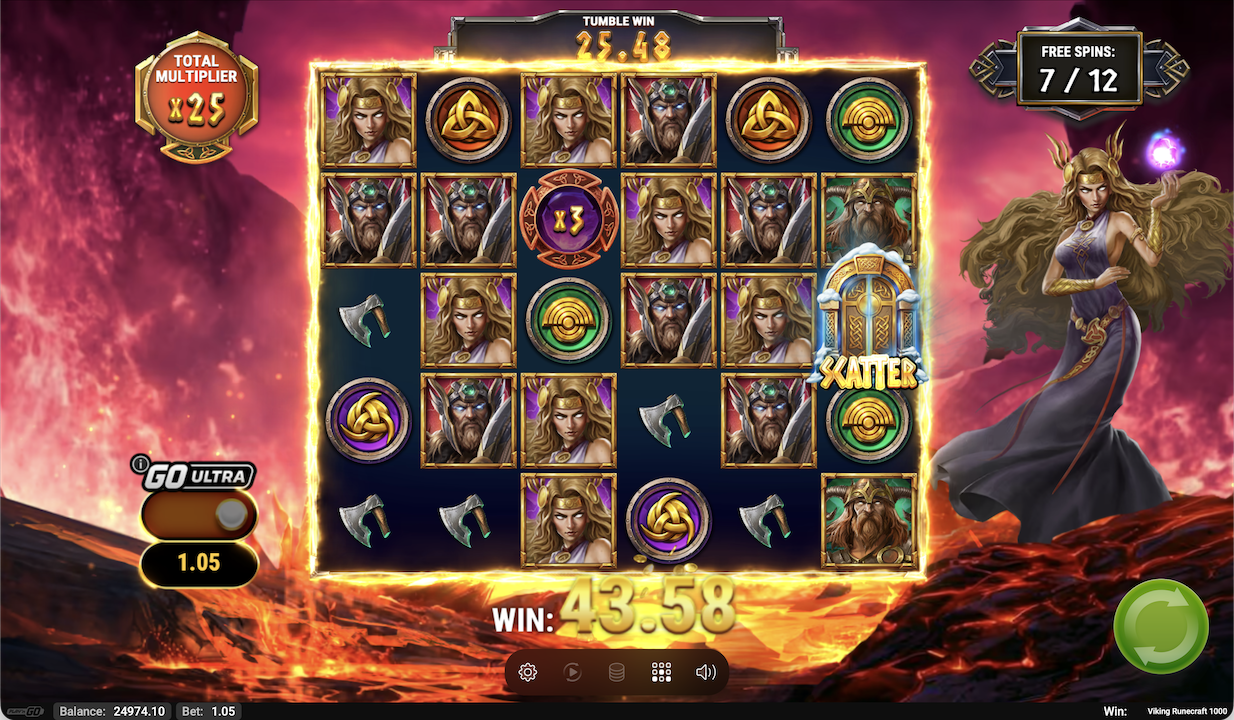
The OG and Viking Runecraft Apocalypse used a 7x7 grid with 5-symbol connected clusters. Viking Runecraft 100 used a 5x5 grid requiring 3 matching symbols in a row. Viking Runecraft 1000 discards connected lines, switching to a 6x5 grid where 8 or more matching symbols pay anywhere on screen.
You will recognize this 6x5 scatter pays engine from Rise of Olympus 1000. Both slots share the same 10 out of 10 volatility rating and 3,000,000 coin cap. However, while Rise of Olympus 1000 uses Greek deity powers to clear symbols and spawn wilds on non-winning drops, Viking Runecraft 1000 routes its features along a unified progressive god path (Heimdall, Freya, Thor) and adds the optional GO Ultra side-bet.
Multipliers land directly on the grid across 15 stages, starting at x2 and climbing through x5, x25, x100, and x500, up to x1000. When a multiplier lands on a winning spin, it upgrades by 1 stage. Subsequent tumbles can trigger a Volatile Upgrade, which skips the ladder and boosts the symbol straight to x1000. Active multipliers sum together at the end of the tumble.
The Persistent Vault
Landing 3 scatter symbols triggers 12 free spins. You no longer need to fill a 40-symbol charge meter like the 2017 version or a 65-symbol runic meter like Viking Runecraft Apocalypse.
During free spins, every multiplier symbol that contributes to a win moves into an on-screen multiplier container. Unlike Viking Runecraft 100, where multipliers reset between spins, this vault holds your sum across all 12 spins, capping at x9999. This creates a compounding snowball effect: early wins build the vault value, so even a modest 2x base win on spin 11 gets multiplied by the accumulated bank. Toggling the GO Ultra side-bet guarantees that any active multiplier symbol upgrades by 1 stage on every winning tumble, capping the single-spin multiplier sum at x3004.
Final Thoughts
Viking Runecraft 1000 abandons the slow meter grinds of its 2017 predecessor for speed and high variance. By switching to a 6x5 scatter pays format and setting the max win odds to 1 in 100 million, Play'n GO created a slot where a 60,000x payout is a far more realistic gamble than the smaller caps of the past.
Read Next
If you want this exact same 60,000x math model in a Greek mythology setting, see our article on Rise of Olympus 1000.